Commercial HVAC equipment costs have surged significantly in recent years. Wholesale manufacturing prices jumped roughly 46% over a five year period according to the U.S. Bureau of Labor Statistics. Between raw material volatility and the mandatory shift to A2L refrigerants, the mistakes that used to be recoverable are becoming more and more expensive.
Many procurement failures occur when buyers fail to ask the right questions before issuing a purchase order. This guide covers the most common commercial project pitfalls and the questions needed to prevent them.
Terminology: What is an A2L Refrigerant?
Think of refrigerant as the chemical fluid that acts like the blood of your HVAC system. It absorbs heat from inside your building and moves it outside. For decades, the industry relied on refrigerants that were highly effective but had a massive impact on global warming if they leaked. The EPA is now phasing those out.
The new, legally mandated replacements are known as A2L refrigerants. While they are significantly better for the environment, the letter A stands for low toxicity, and the 2L designation means they are mildly flammable.
Why the A2L Transition Matters in 2026
Because A2L refrigerants are mildly flammable, this transition represents a hard reset for commercial HVAC. You cannot simply pump an A2L refrigerant into an older HVAC unit. The new generation of equipment requires specialized built in leak detection sensors, upgraded ventilation safety protocols, and specific technician certifications. Overlooking these requirements during procurement creates immediate regulatory, safety, and financial liabilities.
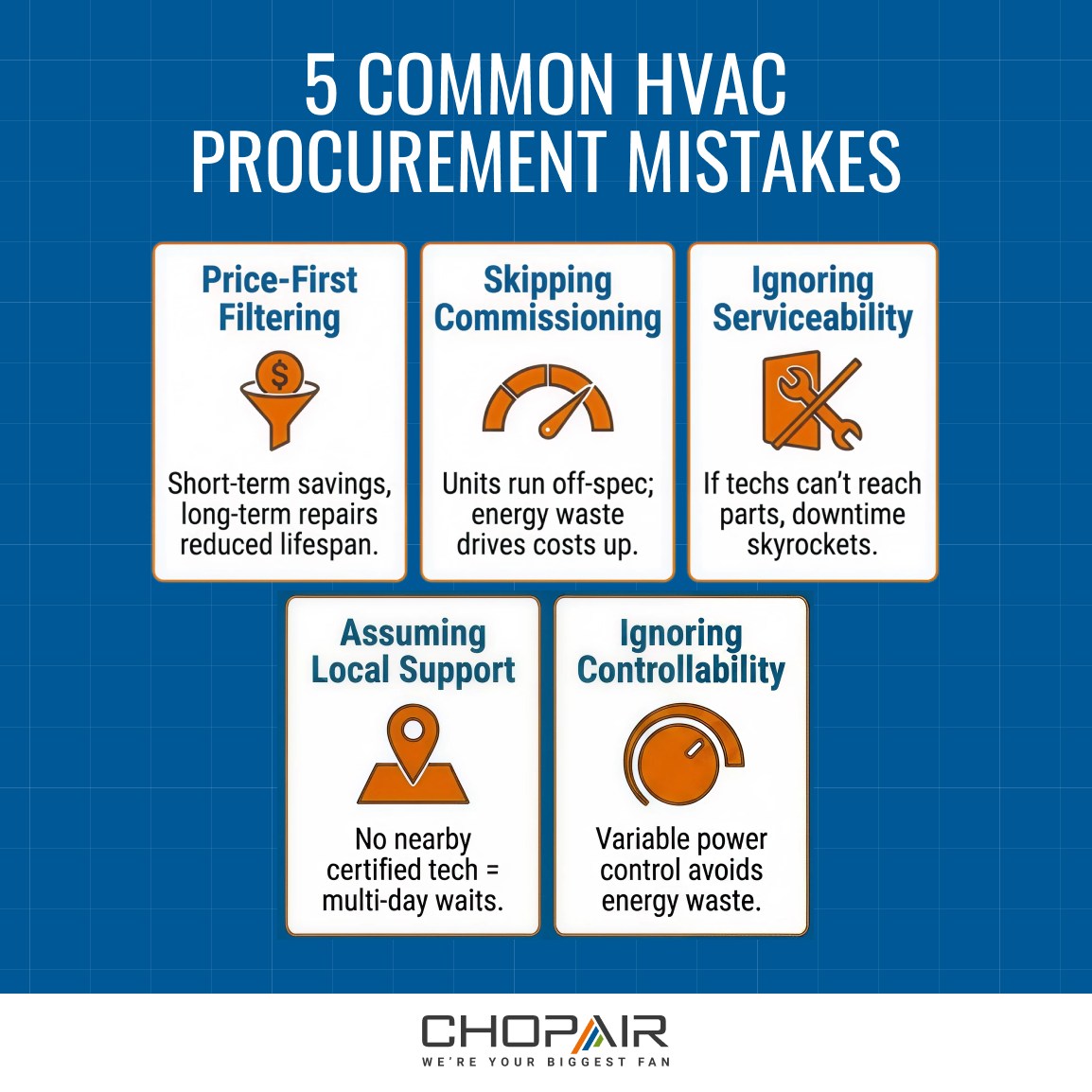
5 Common Procurement Pitfalls
- Price First Filtering: Trying to save money at purchase often leads to costly emergency repairs and a reduced equipment lifespan down the line.
- Skipping Commissioning: When units run outside design parameters, energy is wasted and operating costs grow.
- Ignoring Serviceability: Advanced units are useless if a technician cannot physically reach the internal components to fix them.
- Assuming Local Support: A same day repair becomes a multiple day wait costing thousands of dollars if the nearest certified technician is multiple states away.
- Ignoring Controllability: Variable capacity units that modulate output to match exact building loads eliminate the energy waste of basic on and off cycling, improving comfort and lowering utility expenses.
The Pre Purchase Checklist: 8 Questions to Ask Before You Sign
You know the common pitfalls we see every day. Ask these questions upfront to surface problems before they reach the job site.
1. What is the actual lead time for replacement parts in this region?
- Ask specifically about high failure risk components like compressors, control boards, and heat exchangers.
- If the nearest distribution point is two states away, your parts are a week out. Degraded operation carries a tangible dollar value for commercial facilities.
2. Does the local service branch have factory certified technicians for this specific model?
- High efficiency or application specific equipment requires factory certification that not every local shop carries.
- If the provider must call in a specialist, ask about their distance, typical response time, and who covers the costly travel fees.
3. What is your protocol if the unit fails to start during commissioning?
- A dead on arrival unit requires a crane for removal, creating a significant unplanned expense.
- Determine who pays for the crane, the replacement timeline, and if the manufacturer carries regional buffer stock for emergencies.
4. Are replacement parts accessible to any certified technician, or does this unit use proprietary components?
- Some manufacturers build units with proprietary control systems and sensors sourced only through their own supply chain.
- Ask about control boards, sensors, and refrigerant metering devices to ensure you can maintain the equipment during supply chain disruptions.
5. Is this unit’s A2L leak detection system integrated into the unit, or is it a separate add on?
- A2L compliance is a baseline requirement, but implementation varies significantly between manufacturers.
- Integrated systems are generally more reliable and easier to service. Separate add on systems can introduce ongoing maintenance complexity.
6. Do you have a designated Technical Service Representative at the factory level who will know this project by name?
- A Technical Service Representative is a factory engineer who can walk a technician through non standard fault diagnoses in real time.
- Vague answers to this question are an immediate red flag.
7. Is there a minimum of 36 to 48 inches of clearance around all high voltage panels and primary maintenance access points?
- Inadequate service clearance can create OSHA compliance exposure and code violations that affect your certificate of occupancy.
- Confirm clearance requirements before the equipment layout is finalized rather than on crane day.
8. Does this unit utilize variable capacity modulation or basic on and off cycling?
- Variable capacity units that modulate output to match exact building loads eliminate the energy waste of basic on and off cycling.
- This capability significantly improves interior comfort while lowering utility expenses.
The Bottom Line
The purpose of asking these questions upfront is to determine whether your provider has thought through the full lifecycle of your equipment. Providers who can answer clearly, specifically, and without hedging are the ones worth working with. If you want to review your next equipment decision before the purchase order goes out, reach out to the ChopAir team.