
Commercial Building Management Systems • Lynxspring • Tridium Niagara
Turnkey BMS: One Platform for Total Facility Intelligence
ChopAir delivers turnkey open-protocol Building Management Systems to commercial and industrial facilities of any size, powered by Lynxspring hardware and the Tridium Niagara Framework. One throat to choke. One team from design through commissioning.
Building Management Systems, Explained
Your building can have a nervous system. Here’s what that means.
A Building Management System (BMS) — sometimes called a Building Automation System (BAS) — is the centralized control platform that ties together every mechanical and electrical system in a facility: HVAC, lighting, refrigeration, ventilation, VFDs, and more. Without one, those systems operate independently, often inefficiently, and with no visibility into how they’re actually performing.
Centralized Control
All mechanical and electrical systems — HVAC, fans, dampers, VFDs, refrigeration — managed from a single interface. No more logging into four separate systems to understand one building.
Real-Time Visibility
Live dashboards show energy consumption, equipment performance, and system health across your entire facility. Problems surface early, before they become failures.
Energy Optimization
Systems run when needed, at the right capacity — not continuously at full load. Scheduling, setpoints, and power monitoring translate directly into measurable utility savings.
Analytics & Maintenance
A properly configured BMS monitors trends and surfaces anomalies — but you have to tell it what to watch for. ChopAir configures analytics alerts tuned to your specific equipment and operational patterns.
Not sure if your facility needs a BMS?ChopAir can walk through your current setup and tell you what you’re missing — and what it’s costing you.
The Importance of BMS for Commercial & Industrial Facilities
Three facility types. Three very different outcomes.
Most facilities fall into one of three categories. The difference in operating cost, reliability, and visibility between them is significant — and often invisible until something goes wrong.
Facility 1: No BMS — Flying Blind
This facility relies on factory settings and the hope that commissioning was done correctly on day one. Maintenance happens only after a failure. Energy bills are a monthly mystery. Nobody knows how the building is actually performing until a tenant complains or equipment breaks down. This describes more commercial and industrial facilities than most operators want to admit.
Facility 2: Multiple Manufacturers, No Common Language
This is the most common scenario in existing commercial facilities. You have three pieces of equipment from three different manufacturers, each with its own factory controls — and none of them talk to each other. ChopAir can solve this two ways: integrate directly into the existing factory controls and pull them all into a unified BMS platform, or add controls to “dumb” equipment that was never connected in the first place. Either path gets every system speaking the same language. This is exactly where Tridium Niagara shines — its completely open architecture supports virtually every protocol, so it doesn’t matter what manufacturer built the equipment. If it communicates, Niagara can talk to it.
Facility 3: Turnkey BMS — Complete System, One Team
Every system is synchronized under one open platform. The BMS isn’t just turning fans on and off — it’s monitoring performance trends, surfacing analytics based on the scenarios you actually care about, and giving the facility team a real-time picture of what the building is doing. One provider owns the whole system. One call fixes problems. One dashboard shows everything.
The Technology Behind It
Lynxspring hardware. Tridium Niagara software. Open by design.
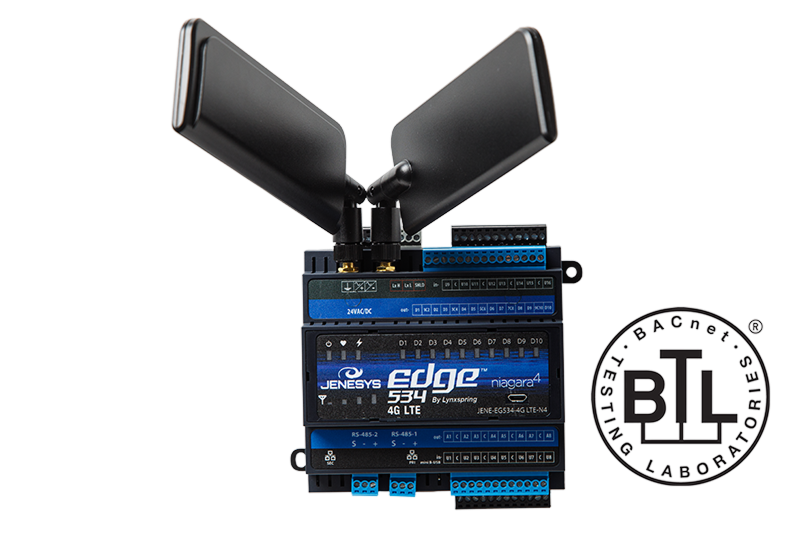
ChopAir’s turnkey BMS is built on two proven platforms: Lynxspring’s JENEsys® controllers and the Tridium Niagara Framework. Together they deliver an open, scalable, and secure system that isn’t locked to any single manufacturer’s ecosystem.
Lynxspring JENEsys® Controllers
Lynxspring is headquartered in the Kansas City metro — Lee’s Summit — which means fast hardware support, reliable supply chain access, and a team ChopAir can reach directly when a project needs it. JENEsys controllers are the field-level hardware that connects physical equipment to the Niagara platform.
Hardware Capabilities
Multi-protocol I/O Edge computing VFD integration Modbus RTU/TCP BACnet MS/TP & IP LonWorksTridium Niagara Framework
Niagara is the world’s most widely deployed open building automation platform, backed by Honeywell. It communicates with virtually any protocol, which means your chiller, your air handlers, your VFDs, and your gas detection system can all talk to each other — regardless of manufacturer — without expensive custom integration work.
Protocol Support
BACnet Modbus LonWorks MQTT OPC-UA REST/HTTPEdge-to-Enterprise Dashboard
The Lynxspring E2E dashboard gives facility managers a real-time view of every property in their portfolio. Track any KPI you choose, view live performance graphs, and spot inefficiencies across multiple sites from your desktop or mobile device.
Dashboard Features
Real-time KPI tracking Multi-site visibility Mobile access Custom reporting Trend loggingCybersecurity Built In
The Tridium/Honeywell foundation includes enterprise-grade cybersecurity protocols at its core. For government, healthcare, or high-security industrial clients, ChopAir can design air-gapped-ready architectures and legacy protocol support that keeps connected systems from becoming vulnerable ones.
Security Features
Encrypted communications Role-based access LonWorks legacy support Air-gapped configurationsWhat ChopAir Actually Does
Turnkey means turnkey. You get a complete, working system.
Most controls contractors provide controls. Most equipment reps provide equipment. ChopAir provides both — and ensures they talk to each other. That’s what makes us more turnkey than most: you don’t end up with a BMS that works and equipment that doesn’t integrate. You end up with a complete system, coordinated from day one, that does exactly what it was designed to do.
Design & Engineering
Complete engineering documents: sequences of operations, I/O schedules, point lists, and system architecture drawings. The spec is complete before anything gets installed.
Equipment & Controls Supply
ChopAir supplies both the mechanical equipment and the controls — and makes sure they’re compatible before anything ships. No mismatches, no last-minute surprises when the equipment arrives on site.
Coordination & Bidding
ChopAir manages the bid process, coordinates with mechanical and electrical contractors, and keeps the project moving. One team owns the schedule.
Installation & Integration
Controllers, wiring, sensor integration, VFD connections — all coordinated by ChopAir. Existing equipment gets brought into the platform where possible. New equipment is integrated and verified from day one.
Commissioning & Handoff
ChopAir commissions the completed system, verifies every sequence of operations, and trains your facility team before closing the project. You receive a complete, documented system — not a black box.
The Operational Case for BMS
What a properly configured BMS does for your facility
Meeting code minimums is the floor, not the ceiling. The facilities that get the most out of a BMS treat it as active infrastructure: a platform that changes how the building runs every day.
Power Monitoring: See Exactly Where Your Energy Is Going
Power monitoring is one of the highest-value and least-talked-about capabilities of a modern BMS. ChopAir has deployed it for major retail and commercial clients, and the visibility it provides is genuinely different from what most facility teams are used to. The system monitors all power coming into and out of your building and surfaces discrepancies: equipment consuming more energy than it should, usage spikes during unoccupied periods, utility billing anomalies that are costing you money without anyone noticing. Combined with occupancy-based scheduling — which automatically shifts the building between occupied and unoccupied modes with appropriate setpoints — the energy savings from a properly configured BMS are consistent and measurable from day one.
Analytics: The System Watches What You Tell It To Watch
The BMS doesn’t instinctively know what matters to your operation — you have to configure it. That’s where ChopAir’s expertise makes the difference. Using the E2E analytics platform, ChopAir can configure alerts and monitoring logic for virtually any scenario: a piece of equipment running outside its normal parameters, a motor drawing more current than baseline, a system that’s been pushed into manual override by a technician and never returned to automatic. That last one is more common than most facility managers realize, and it’s a red flag every time it happens. ChopAir works with your team to identify the scenarios that matter most and builds the analytics layer around them.
Protocol Freedom: Stop Being Locked In
Most proprietary BMS platforms act as a digital fence around your building. Add a chiller from one manufacturer and an air handler from another, and suddenly you need expensive custom integration work to make them communicate. Tridium Niagara speaks BACnet, Modbus, LonWorks, MQTT, and more — natively. That means you’re not locked into any single equipment manufacturer. You can choose the best product for each application and know it will integrate cleanly into the platform.
Retrofit Ready: Existing Equipment Isn’t Always Dead Equipment
A BMS project doesn’t have to mean replacing every mechanical asset in the building. ChopAir’s approach to retrofit projects starts with an honest assessment of what has life left in it. Older HVAC equipment can often be brought into the BMS platform with better controls, sensors, and monitoring — delivering most of the performance benefits at a fraction of the equipment upgrade cost. The platform grows with the building rather than requiring a full replacement cycle to stay relevant.
Multi-Site Management: One Dashboard, Every Property
For facility managers and property operators running multiple buildings — whether it’s a portfolio of warehouses, a campus of commercial properties, or a chain of retail locations — the Edge-to-Enterprise dashboard changes how oversight works. Real-time performance data from every site in one view, from a desktop or mobile device. Outliers are obvious. Inefficiencies are visible before they appear on the utility bill. And when a site needs attention, the data is already there to diagnose it.
Who This Is For
Facilities where BMS makes the biggest difference
Any facility with multiple interconnected mechanical systems benefits from centralized control. These are the building types where ChopAir most commonly deploys BMS solutions.
Industrial & Manufacturing
High-bay facilities with complex ventilation, process cooling, and compressed air systems. Multiple mechanical systems, high energy loads, and maintenance teams that need accurate real-time data to stay ahead of failures.
Warehouses & Distribution
Large footprints with high ventilation loads, dock doors, refrigerated zones, and HVLS fans. Demand-controlled ventilation and power monitoring deliver some of the fastest paybacks in this building type.
Commercial Office & Retail
Multi-zone HVAC, lighting, and building envelope systems that need coordinated scheduling and setpoint management. Occupancy-based control and automated setbacks reduce energy consumption significantly in large commercial footprints.
Cold Storage & Refrigeration
Facilities where refrigeration reliability is mission-critical and energy consumption is a dominant operating cost. BMS integration with refrigeration controls provides compressor monitoring, setpoint optimization, and power monitoring across refrigeration loads.
Healthcare & Education
Facilities with strict air quality requirements, complex ventilation sequences, and high occupant sensitivity to HVAC performance. BMS platforms provide the documentation and control precision these environments require.
Government & Institutional
Facilities that require cybersecurity compliance, audit trails, and long-term maintainability by in-house staff. Tridium’s open architecture and ChopAir’s documentation package are designed to outlast any single vendor relationship.
BMS & LEED Certification: A Connection Worth Knowing About
Adding a BMS to a new construction project can qualify the building for credit toward LEED certification — one of the most recognized green building standards in commercial real estate. LEED credits related to energy monitoring, optimized energy performance, and enhanced commissioning all align directly with what a properly configured BMS provides. For developers and owners pursuing LEED certification, a turnkey BMS from ChopAir can contribute meaningfully to your certification level. Talk to your LEED consultant and to ChopAir early in the design process — this is much easier to plan for than to retrofit.
Ask ChopAir about BMS and LEED →Have a specific facility in mind?ChopAir will walk through your building type, mechanical inventory, and operational goals before recommending a system configuration.
Why ChopAir for BMS
Common questions. Straight answers.
What makes ChopAir different from a standard controls contractor?
Most controls contractors provide controls. Most equipment reps provide equipment. ChopAir provides both — and ensures they’re compatible and integrated before anything is commissioned. You get one accountable team from design through handoff, not a finger-pointing situation between your equipment vendor and your controls vendor.
Will I be locked into ChopAir or Lynxspring for future upgrades?
No. Tridium Niagara is genuinely open. The platform supports virtually every protocol — BACnet, Modbus, LonWorks, and more — so future equipment from any manufacturer integrates cleanly. You own the system.
We have existing equipment from multiple manufacturers. Can ChopAir work with what we have?
Yes, and this is one of ChopAir’s strengths. We can integrate directly into existing factory controls and pull them into the BMS, or we can add controls to equipment that has never been connected. Either way, the result is a unified platform that speaks to everything in the building.
How long does a BMS project typically take?
It depends on building size and complexity. Small to mid-size retrofit projects typically run several weeks from design to commissioning. New construction projects are coordinated with the build schedule from the design phase. ChopAir will give you a realistic timeline at the start of the engagement.
Does ChopAir work on both new construction and existing buildings?
Both. New construction projects benefit from designing the BMS in from the start, which reduces installation cost and complexity. Existing facilities can be retrofitted incrementally. ChopAir has done both and can advise on the right approach for your situation.
Where does ChopAir work?
ChopAir’s primary markets are Kansas City, Texas, and Florida. We also take select projects outside these areas. Lynxspring’s hardware base in Lee’s Summit means local support is available for Kansas City area clients.

Talk to ChopAir
BMS Design & Integration Specialists
Ready to see what a turnkey BMS looks like for your facility?
ChopAir walks through your building, your equipment, and your goals — before recommending anything.
Email ChopAir Call ChopAir
Get Started
The right BMS for your facility starts with the right conversation.
ChopAir delivers turnkey Building Management Systems powered by Lynxspring and Tridium Niagara — from design through commissioning — for commercial and industrial facilities across Kansas City, Texas, and Florida.