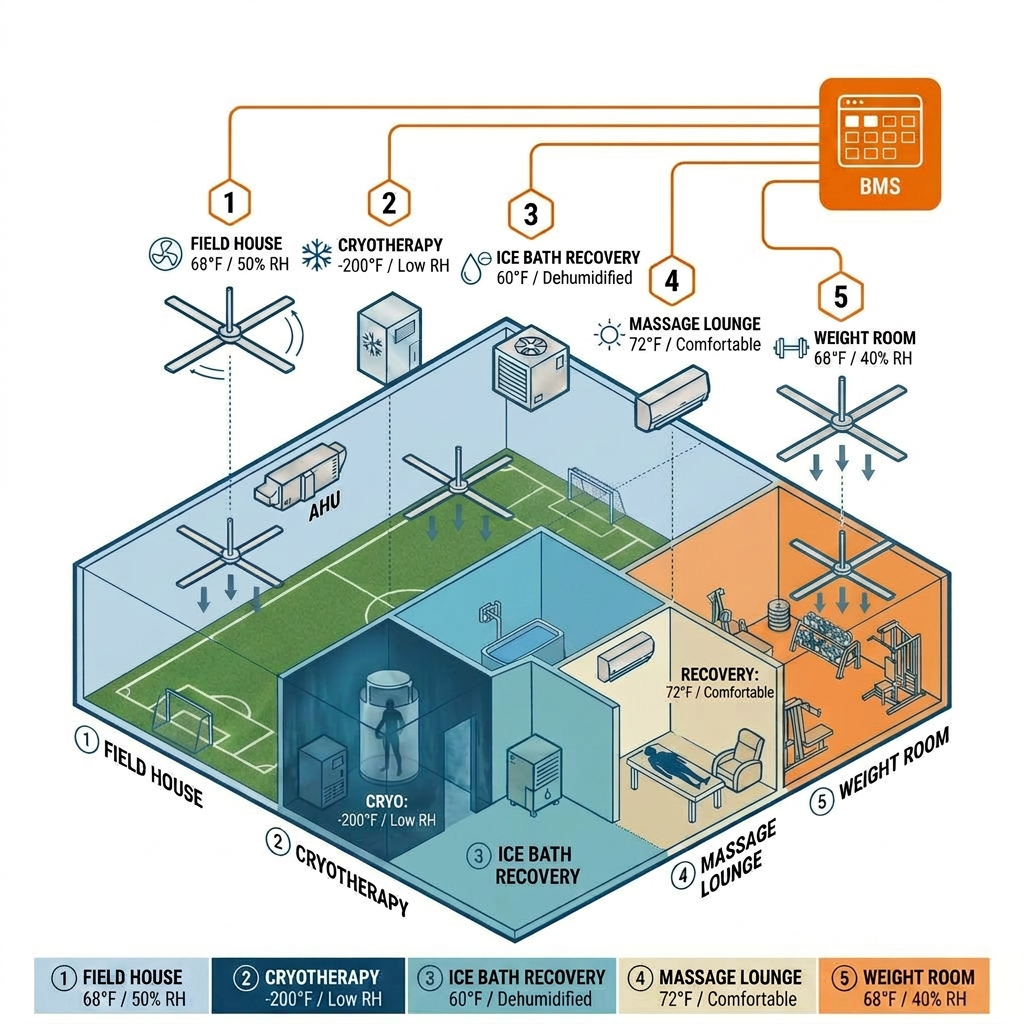
When people picture an indoor training facility, they usually picture one thing: a big open field or court with some fans and a thermostat somewhere on the wall. And for the practice field itself, that’s not far off. But walk through the rest of a modern athletic facility, especially one built or renovated with elite-level training in mind, and you’ll find a building that’s actually five or six very different buildings stitched together under one roof.
The practice field needs air movement and humidity control for athletes generating enormous heat loads. The cryotherapy room needs to stay cold and dry, sometimes dramatically so. The ice bath area deals with high humidity and constant moisture at floor level. The massage and recovery rooms need to feel warm, calm, and comfortable for athletes whose bodies are trying to wind down. And somewhere in the mix, there’s probably a weight room working just as hard as the field itself.
Every one of these spaces has its own ideal temperature, humidity range, and air quality requirements. And in a lot of facilities, they’re all fighting the same HVAC system for control.
Why This Matters More in Humid Climates
In a place like Kansas City, where summer humidity sits heavy in the air for months at a time, this problem gets harder. Outdoor air brought into the building carries a serious moisture load. If a facility’s HVAC system is only designed to handle temperature, that humidity has to go somewhere, and it usually ends up in the spaces where it does the most damage.
Cryotherapy rooms are particularly sensitive here. These spaces operate at extremely low temperatures, and if humidity isn’t controlled before that air reaches the cryo unit, you get frost buildup, equipment strain, and a room that never quite holds its setpoint the way it should. Ice bath areas have the opposite problem: constant evaporation off the water surface means humidity needs to be actively removed, or you end up with condensation on walls, slippery floors, and an environment that feels damp no matter what the thermostat says.
Meanwhile, the practice field itself is dealing with dozens of athletes pushing heat and moisture into the air during intense training. If that air isn’t properly conditioned and moved, it doesn’t just make the space uncomfortable, it can affect performance, recovery times, and even the lifespan of the building’s structure and equipment.
The Core Problem: One System Trying to Do Five Jobs
A lot of facilities, especially older ones, or newer ones built without a unified plan, end up with HVAC systems that were designed zone by zone, with each space getting whatever equipment made sense at the time. The result is a building where the practice field’s air handler is fighting the recovery wing’s humidity, where the cryo room’s dehumidification is disconnected from the rest of the building’s controls, and where nobody on the facilities team has a clear picture of what’s actually happening across the whole space.
This isn’t just an efficiency problem, though it’s certainly that. It’s a reliability problem. When systems aren’t talking to each other, small issues compound. A dehumidifier that’s slightly undersized for the ice bath area doesn’t just affect that room, it can push moisture into adjacent spaces, affect the cryo room’s ability to hold setpoint, and increase the load on the main HVAC system trying to compensate.
Where BMS Comes In
This is exactly the kind of problem a properly configured Building Management System is built to solve. Instead of five or six independent systems each doing their own thing, a BMS ties everything together, bringing the practice field’s HVAC and HVLS fans, the cryo room’s dedicated cooling and dehumidification, the ice bath area’s moisture removal, and the recovery rooms’ comfort conditioning into one platform with real visibility into what’s happening everywhere, all the time.
The practical benefit is enormous. If humidity in the ice bath area starts climbing, the system can respond before it becomes a problem in adjacent spaces, rather than after someone notices condensation on a wall. If the cryo room’s dehumidification is working harder than it should be on a particularly humid August day, that shows up as a trend the facilities team can act on, not a mystery that gets investigated after the unit fails.
And because each space has different requirements, having them on an open platform matters. The cryo room might need a specialized dehumidification unit from one manufacturer, the practice field might run HVLS fans alongside a separate air handling system, and the recovery rooms might just need standard zone-controlled comfort conditioning. An open BMS built on a platform like Tridium Niagara means all of that equipment, regardless of who made it, can be monitored and controlled from the same dashboard, instead of facilities staff needing to learn five different proprietary interfaces to understand one building.
Getting the Equipment Mix Right From the Start
The other half of this equation is making sure the right equipment is specified for each space in the first place. A practice field benefits from HVLS fans paired with proper ventilation to keep air moving across a large open area and prevent the kind of stagnant, humid pockets that build up near the playing surface. Recovery and cryo spaces often need dedicated dehumidification equipment sized specifically for their moisture loads, not just whatever capacity happens to be left over from the main system. And in a humid climate, dedicated outdoor air systems that handle moisture removal separately from temperature control can make the difference between a facility that fights humidity all summer and one that barely notices it.
None of this works well as an afterthought. The facilities that get this right are the ones where the HVAC design accounts for these different zones from the beginning, and where the controls infrastructure is planned to tie them together rather than leaving each space to operate in isolation.
The Bigger Picture
As more training facilities are built or renovated to meet the standards expected for major events and elite-level programs, the gap between a building that just has air conditioning and a building that actually manages its indoor environment is becoming more visible. Athletes and coaches notice when a recovery room doesn’t feel right, when a cryo session doesn’t hit the temperatures it’s supposed to, or when a practice field feels heavier and more humid than it should.
Getting this right isn’t about throwing more equipment at the problem. It’s about understanding that a training facility isn’t one space with one set of requirements, it’s several spaces with very different needs, all under one roof, that work best when they’re designed and controlled as a coordinated system rather than a collection of separate problems.
Have questions about HVAC design, ventilation equipment, or BMS integration for athletic or recovery facilities? ChopAir works with commercial and industrial clients across the region to design systems that account for the full picture, from the practice field to the recovery room.