What Are HVLS Fans?
HVLS (High-Volume, Low-Speed) fans are large-diameter fans, typically 8–24 feet across, designed to deliver massive airflow across wide-open areas with minimal obstructions.
Key Features & Benefits
- Wide Coverage: Moves air gently across wide areas, allowing one fan to cover thousands of square feet.
- Year-Round Utility: Breaks up stagnant air year-round, helping with evaporative cooling in the summer and even heat distribution in the winter.
- Environmental Control: Reduces hot spots, stagnant air, and humidity variations that can affect comfort, worker safety, and stored inventory.
- Ideal Mounting: Typically mounted from high ceilings in warehouses, manufacturing floors, or distribution centers.
What Are HVHS Fans?
HVHS (High-Volume, High-Speed) fans are portable, smaller-diameter fans designed to deliver strong, directional airflow to a specific, targeted area.
Key Features & Benefits
- Targeted Airflow: Typically 36–48 inches in diameter, these units move air with speed and directional control, delivering a noticeable breeze up to 90 feet away.
- Fast Relief: Primarily used to quickly break up stagnant, hot air in a specific zone, especially near machinery or in areas where workers are concentrated.
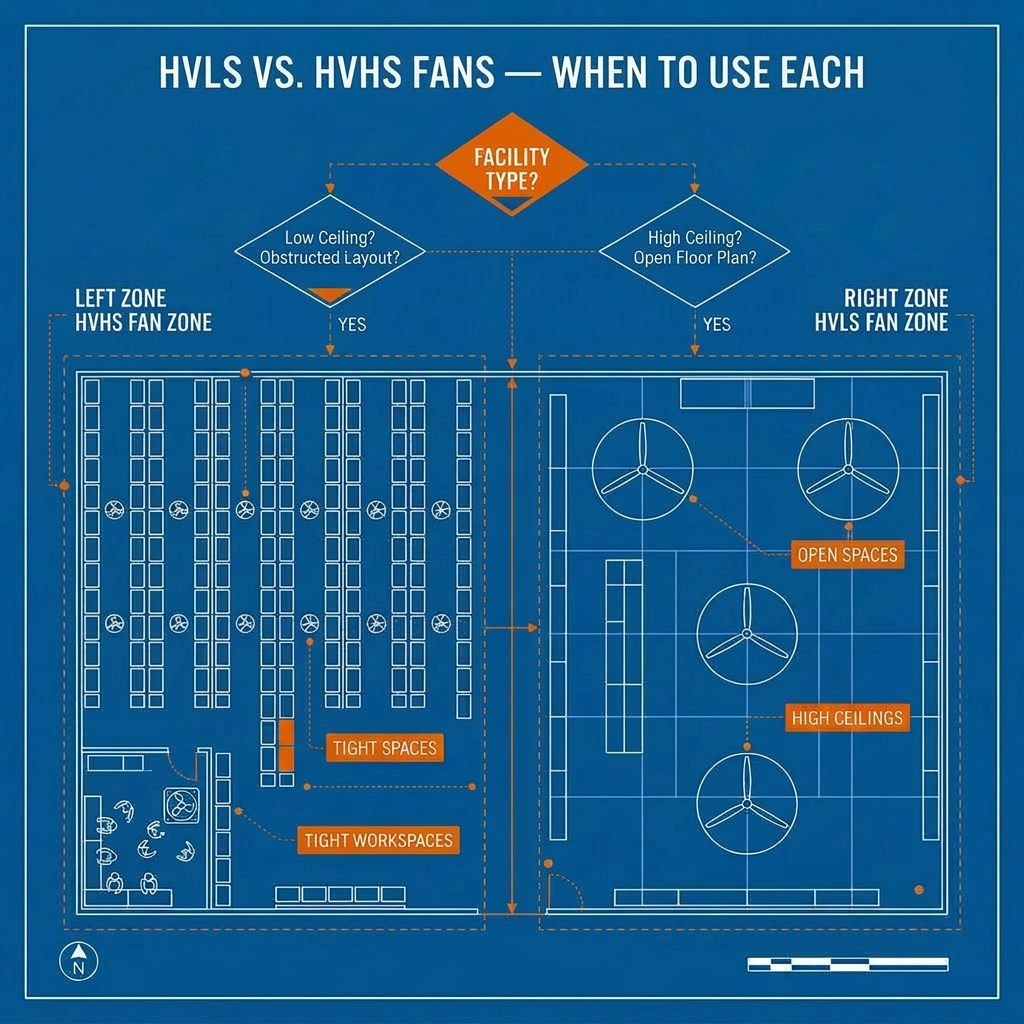
- Flexible Placement: Available as portable floor units or ceiling column mounts, making them ideal for low ceilings, mezzanines, rack aisles, or areas with obstructions where an HVLS fan won’t fit.
Why Air Movement Matters Year-Round
It’s a common misconception that industrial fans are mainly about cutting energy bills. In reality, the bigger story for both HVLS and HVHS fans is what happens when stagnant air gets broken up: comfort goes up, safety risks go down, stored inventory holds up better, and equipment runs longer.
Stagnant air creates hot, humid pockets where heat and moisture have nowhere to go. That’s a comfort problem for anyone working in the space, but it’s also a safety problem: heat stress, fatigue, and slip hazards from condensation all become more likely when air isn’t moving. For facilities storing temperature- or humidity-sensitive inventory, stagnant air can also mean spoiled product or degraded materials. And for equipment, especially motors, electrical panels, and machinery that generates its own heat, consistent air movement helps prevent the kind of heat buildup that shortens service life.
Comfort is probably the most overlooked benefit of all. Most people assume the only way to make a room feel cooler is to lower the temperature, so air movement gets treated as an afterthought instead of a real solution. But moving air lowers the effective dew point at skin level, which creates a genuine perceived cooling effect even when the thermostat hasn’t changed at all. A well-placed fan can make a room feel several degrees more comfortable for the people working in it, and because that comfort comes from air movement rather than mechanical cooling, it shows up alongside the safety and air quality benefits at no extra cost to run the HVAC harder.
Key Differences Between HVLS and HVHS Fans
| Feature | HVLS Fans | HVHS Fans |
|---|---|---|
| Diameter | 8–24 ft | 36–48 in (3–4 ft) |
| Airflow | Massive volume, low speed, broad coverage | High volume, high speed, directional control |
| Primary Use | Year-round comfort and air movement across an open area | Targeted airflow in a specific zone |
| Coverage Area | Very large, open areas with minimal obstructions (thousands of sq ft) | Smaller, localized areas (up to ~90 ft throw) |
| Best For | Comfort, safety, and product protection across a whole facility | Comfort and safety in a specific zone or obstructed area |
| Air Movement Feel | Gentle, barely noticeable | Strong, noticeable breeze |
| Installation | Fixed, requires high ceiling clearance and open layout | Portable floor units or ceiling column mount, easy to relocate |
When to Use Each System
Choose HVLS Fans If:
- You manage large warehouses, manufacturing floors, and distribution centers with open layouts and minimal obstructions.
- The space requires consistent, year-round comfort and air movement to protect workers, inventory, and equipment.
- You want broad coverage that reaches every corner of a large open area without relying on multiple smaller units.
Choose HVHS Fans If:
- You are dealing with low ceilings, mezzanines, rack aisles, or areas with obstructions where an HVLS fan won’t fit.
- Workers in a specific zone need fast, noticeable airflow, such as near machinery, loading docks, or production lines.
- You need directional control over where the airflow goes, or a portable solution that can be moved between zones as needs change.
Can You Use Both?
Yes. In many facilities, HVLS fans handle year-round comfort and broad air movement across the main floor, while HVHS fans provide fast, targeted, directional airflow in specific zones, such as near a hot process, a loading dock, or an area where an HVLS fan can’t be installed due to ceiling height or obstructions. Combining both fan types is a common strategy: HVLS fans create a base layer of consistent airflow throughout the facility, protecting comfort, safety, and stored product across the whole space, while portable HVHS fans are deployed wherever extra, targeted airflow is needed most.