
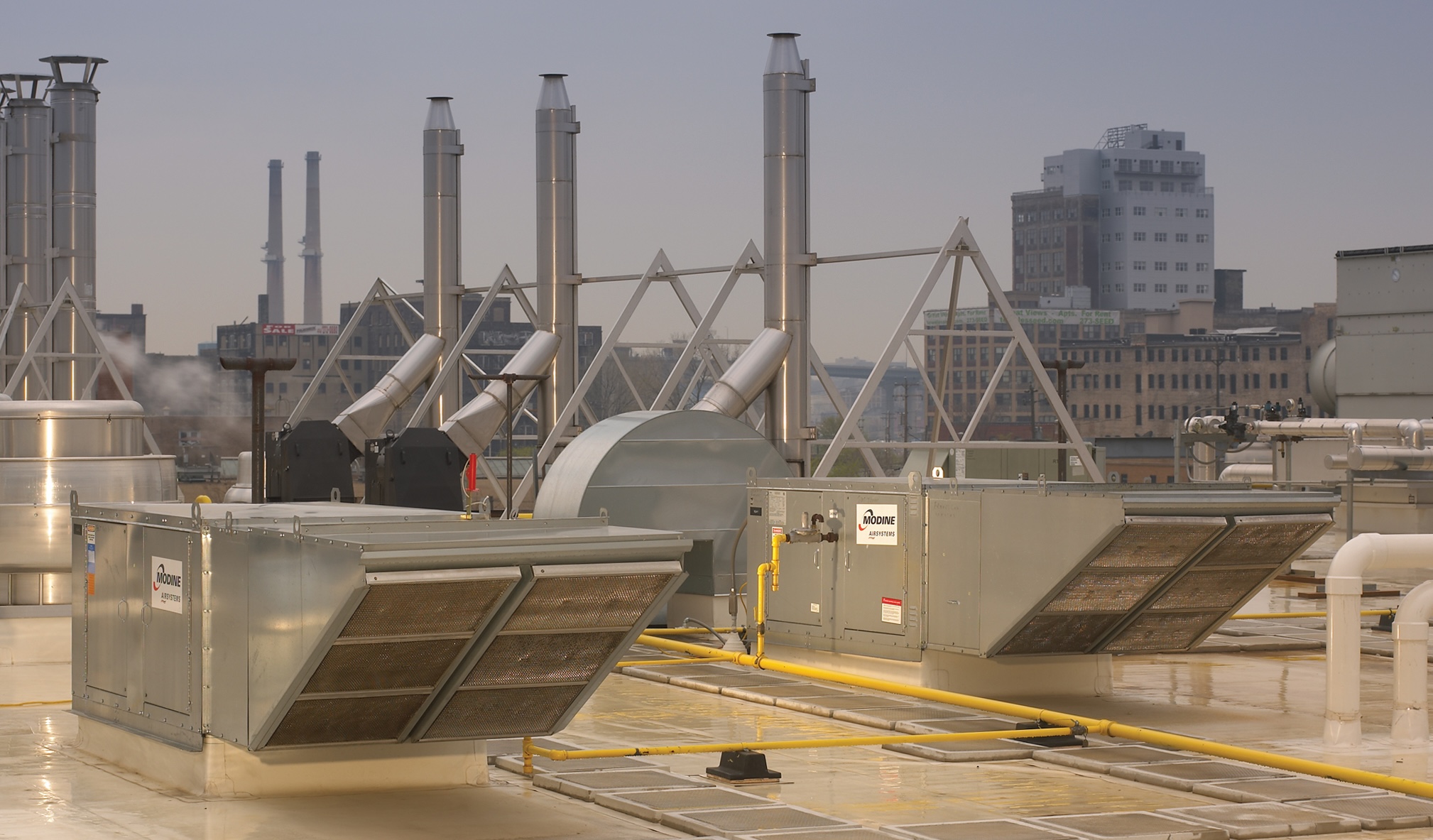
Make-up air units (MAUs) play a critical role in industrial facilities by replacing exhausted air, maintaining building pressure, and supporting indoor air quality. However, improper sizing is one of the most common causes of comfort issues, code violations, and excessive energy use.
This article walks through the key considerations and calculations used to properly size a make-up air unit for an industrial application.
What Is a Make-Up Air Unit?
A make-up air unit supplies 100% outside air to a building to replace air that is exhausted by process exhaust systems, paint booths, dust collection systems, commercial kitchen hoods, and general building exhaust. Unlike comfort air handlers, MAUs are primarily designed to maintain pressure balance while tempering incoming air.
Step 1: Determine Total Exhaust Airflow
The starting point for sizing any MAU is the total exhaust airflow. Add together all sources of exhaust, including process exhaust fans, general exhaust fans, relief air from other systems, and code-required exhaust such as toilets and locker rooms.
Example:
- Paint booth exhaust: 18,000 CFM
- Dust collector exhaust: 7,000 CFM
- General exhaust: 3,000 CFM
- Total exhaust: 28,000 CFM
In most industrial facilities, the MAU is sized to replace 90–100% of total exhaust, depending on pressurization strategy.
Step 2: Decide on Building Pressurization
The amount of make-up air supplied depends on whether the space should be neutral pressure, slightly positive, or negative pressure.
- Neutral: Supply ≈ exhaust
- Slightly positive: Supply 5–10% more than exhaust
- Negative: Supply less than exhaust (process-driven)
Example: 28,000 CFM exhaust × 1.05 = 29,400 CFM MAU
Positive pressurization helps prevent infiltration of dust, moisture, and unconditioned air — a significant consideration in industrial environments with frequent door openings or process exhaust.
Step 3: Verify Code and Ventilation Requirements
In addition to exhaust replacement, ventilation codes may impose minimum outdoor air requirements. Common references include the IMC (International Mechanical Code) and ASHRAE 62.1. In many industrial applications, exhaust replacement dominates the airflow requirement, but minimum ventilation should still be verified to ensure compliance.
Step 4: Establish Design Outdoor Air Conditions
The heating and cooling capacity of the MAU depends on local design outdoor temperature and humidity conditions. Key design points include winter heating design temperature, summer cooling design temperature and humidity, and the required discharge air temperature. These values significantly affect burner size, coil selection, and energy consumption — and vary considerably by geography.
Step 5: Select Discharge Air Temperature
Make-up air units typically deliver air warmer than outdoor air but cooler than room air in winter. Common discharge temperatures range from 55°F to 65°F for direct delivery to the space, with higher temperatures used if the unit is ducted or contributing to space heating. Selecting the lowest acceptable discharge temperature improves efficiency and reduces stratification risk.
Rule of thumb: Higher discharge temperatures increase heating capacity required, fuel consumption, and equipment cost. Don’t set the discharge temperature higher than the application actually demands.
Step 6: Calculate Heating Capacity
Heating capacity is calculated using the following formula:
BTU/hr = 1.08 × CFM × ΔT
- CFM = make-up air airflow
- ΔT = temperature rise from outdoor air to discharge air
Example:
- MAU airflow: 30,000 CFM
- Outdoor design temp: 0°F
- Discharge temp: 60°F
- ΔT = 60°F
- Heating capacity = 1.08 × 30,000 × 60 = 1,944,000 BTU/hr
This value drives gas burner or electric heater selection. On large industrial projects, this number can climb quickly — which is why getting the discharge temperature and pressurization strategy right before equipment selection matters so much.
Step 7: Consider Cooling and Dehumidification
Not all industrial MAUs include cooling, but many do. Cooling may be required for worker comfort, process requirements, humidity control, or preventing condensation on cold surfaces. In humid climates, latent load — moisture removal — is often the controlling factor, and it needs to be accounted for in coil selection.
Step 8: Evaluate Air Distribution and Location
MAU performance depends heavily on how air is delivered. Key decisions include direct-fired vs. indirect-fired, ducted vs. non-ducted, and high-level vs. low-level discharge. Poor air distribution causes drafts, stratification, or short-circuiting with exhaust air — problems that no amount of additional capacity will fix.
Common Make-Up Air Sizing Mistakes
The following mistakes show up repeatedly on industrial projects and are worth calling out explicitly:
- Ignoring intermittent exhaust operation
- Oversizing “for safety” without performing a real load calculation
- Selecting unnecessarily high discharge temperatures
- Failing to coordinate with exhaust fan schedules
- Not accounting for future expansion
These mistakes consistently lead to higher first cost, higher operating expense, and equipment that doesn’t perform as expected.
Working on an industrial project and need help sizing a make-up air unit? The ChopAir team works through MAU selections every day — from initial load calculations to submittal review to coordinating delivery around your construction timeline. Reach out here or browse our MAU lineup at the ChopShop.
Sources: IMC (International Mechanical Code), ASHRAE 62.1, ASHRAE Handbook of Fundamentals, industry field data