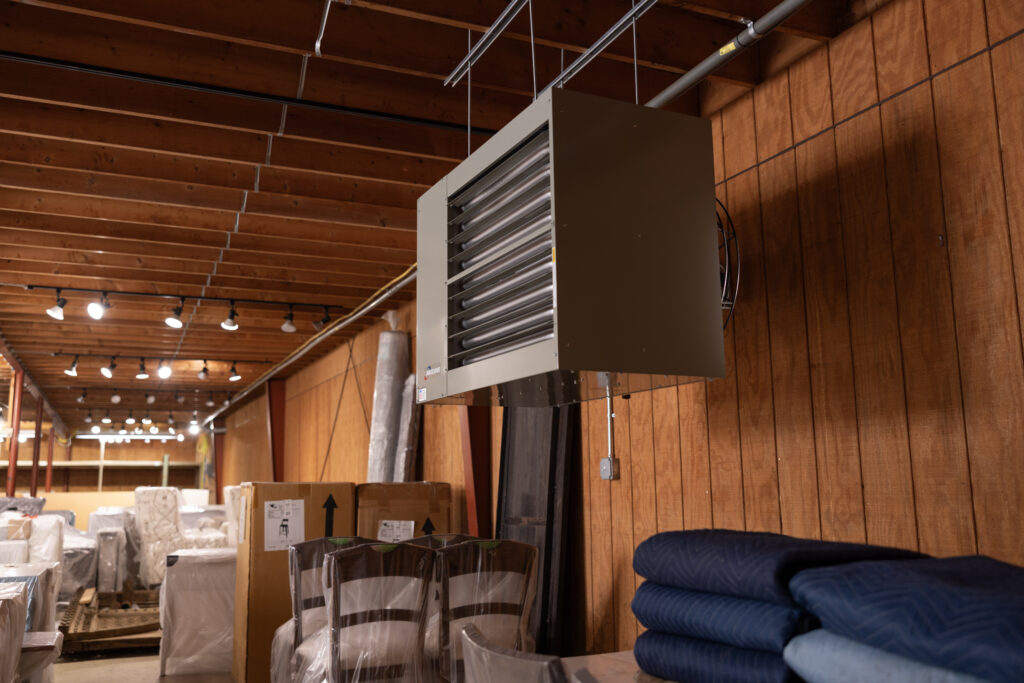
Unit heaters are one of the most common heating solutions for warehouses, manufacturing facilities, garages, and service areas. They’re relatively simple, cost-effective, and reliable — but only when they’re sized and applied correctly.
Unfortunately, unit heaters are frequently oversized, undersized, or poorly applied, leading to comfort issues, short equipment life, and higher operating costs. Here are the most common sizing mistakes and how to avoid them.
Mistake #1: Using Rule-of-Thumb Sizing
One of the most common mistakes is sizing unit heaters based on a quick rule of thumb — “X BTUs per square foot,” “one heater per bay,” or “match what’s already installed.”
Rule-of-thumb methods ignore critical variables like ceiling height, infiltration, insulation levels, and climate. Two buildings with the same square footage can have dramatically different heating loads.
How to avoid it: Always perform a heat loss calculation using building envelope details, design outdoor temperature, infiltration and air leakage, and any applicable internal heat gains.
Mistake #2: Oversizing “Just to Be Safe”
Oversizing is often treated as a conservative choice, but it creates more problems than it solves. Common consequences include short cycling, uneven temperature distribution, increased wear on burners and heat exchangers, and reduced efficiency.
How to avoid it: Size heaters to the calculated load. Rely on modulating or multi-stage burners, proper heater placement, and zoning where needed — not excess capacity.
Mistake #3: Ignoring Infiltration and Air Leakage
Large overhead doors, dock doors, and open bays can dominate the heating load in industrial spaces. If infiltration isn’t included in the load calculation, the space will never maintain setpoint during cold weather — regardless of how much equipment is installed.
How to avoid it: Account for door usage frequency, building pressurization strategy, make-up air systems, and vestibules or air curtains. In many facilities, infiltration load exceeds envelope heat loss.
Often overlooked: In facilities with heavy dock door activity, infiltration can be the single largest component of the heating load — and it’s frequently left out of early calculations entirely.
Mistake #4: Not Accounting for Ceiling Height and Stratification
Unit heaters are often installed in high-bay spaces where warm air naturally rises. Heat stratifies at the ceiling while occupants remain cold at floor level — a problem that more heaters won’t fix.
How to avoid it: Use proper heater discharge direction, select units with adequate throw, and pair heaters with HVLS or destratification fans. Consider lower-mounted heaters in some applications. Air movement is often just as important as heating capacity in these spaces.
Mistake #5: Selecting the Wrong Discharge Temperature
Higher discharge air temperatures can seem like a straightforward way to heat a space faster, but they come with real tradeoffs: increased stratification, greater temperature swings, and higher gas consumption.
How to avoid it: Select heaters that deliver adequate airflow with moderate discharge temperatures. The goal is mixing, not hot spots.
Mistake #6: Poor Heater Placement
Even a correctly sized heater won’t perform well if it’s installed in the wrong location. Common placement issues include positioning too close to exterior walls, discharging directly at doors, short-circuiting supply air to exhaust, and inadequate clearance for airflow.
How to avoid it: Lay out heaters based on air throw patterns, obstructions, occupied zones, and door and window locations. Coverage matters more than nameplate BTUs.
Mistake #7: Overlooking Venting and Combustion Air
Combustion type affects both sizing and performance. Improper venting can reduce efficiency, inadequate combustion air causes nuisance shutdowns, and infiltration from open buildings increases heat loss significantly.
How to avoid it: Use separated combustion where infiltration is high, verify vent lengths and configurations, and coordinate heater selection with building envelope design early in the process.
Mistake #8: Ignoring Zoning and Control Strategy
Large spaces often have varying loads — loading dock areas, production floors, and office adjacencies all behave differently. A single heater or thermostat will overheat some areas while underheating others.
How to avoid it: Break large spaces into zones, use multiple heaters with independent controls, and consider BAS integration for scheduling and setbacks. Controls are part of the sizing conversation, not something to figure out after equipment is selected.
Mistake #9: Failing to Consider Future Changes
Facilities evolve. New doors, process exhaust additions, or layout changes can significantly alter heating loads — and a system designed to the edge of its capacity has no room to adapt.
How to avoid it: Discuss future expansion early, allow reasonable capacity flexibility, and choose equipment with staging or modulation options that can accommodate changing conditions.
The Common Thread
Most unit heater problems trace back to the same root cause: sizing decisions made without a real load calculation, based on what was previously installed or what felt conservative in the moment. The good news is that all of these mistakes are avoidable with the right process and the right people involved early.
Have a warehouse, manufacturing facility, or service facility that needs a heating review? The ChopAir team can help you work through the load calculation, equipment selection, and placement strategy before anything gets ordered. Reach out here or browse our unit heater lineup at the ChopShop.
Sources: IMC (International Mechanical Code), ASHRAE Handbook of Fundamentals, ACCA Manual N, industry field data