If you’re considering fans for your industrial or commercial space, you may have come across HVLS fans and destratification fans. At first glance, they may seem similar—they both move air—but understanding the differences is key to selecting the right solution for comfort, energy efficiency, and HVAC performance. This article breaks down the distinctions, benefits, and applications of each type.
What Are HVLS Fans?
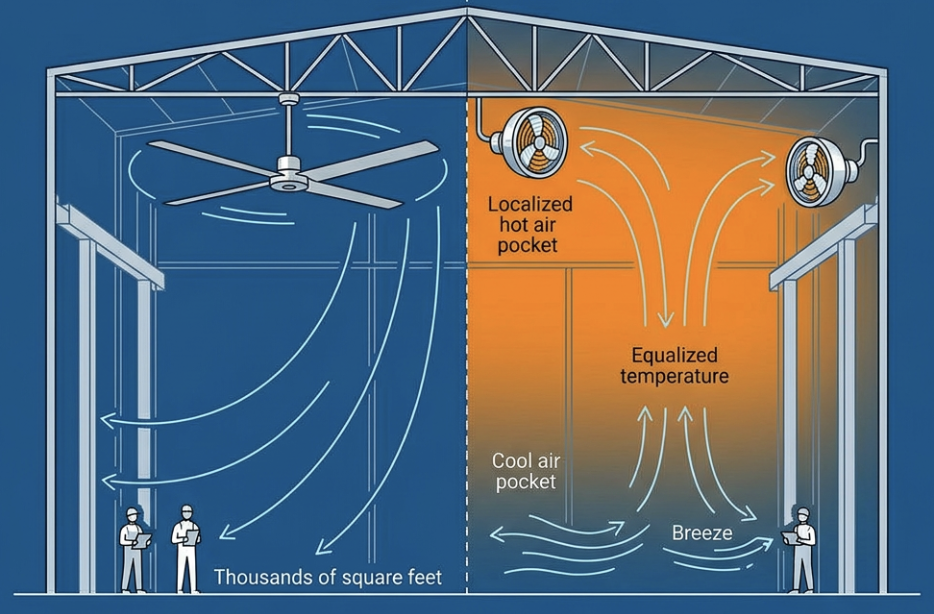
HVLS (High-Volume, Low-Speed) fans are large-diameter fans, typically 8–24 feet across, designed to move large volumes of air slowly.
Key Features & Benefits
- Wide Coverage: Moves air gently across wide areas, allowing one fan to cover thousands of square feet.
- Year-Round Utility: Can be used year-round for evaporative cooling in the summer and heat mixing in the winter.
- Environmental Control: Reduces hot spots, stagnant air, and humidity variations, lowering both heating and cooling costs.
- Ideal Mounting: Typically mounted from high ceilings in warehouses, manufacturing floors, or distribution centers.
What Are Destratification Fans?
Destratification fans are smaller, high-speed fans designed primarily to reduce heat stratification in tall spaces.
Key Features & Benefits
- Targeted Mixing: Typically 1–6 feet in diameter, these units spin faster to mix warm air near the ceiling with cooler air near the floor.
- Winter Optimization: Primarily serves as a winter solution for heat redistribution to improve worker comfort during the heating season.
- Flexible Placement: Reduces temperature differences between the floor and ceiling, and can be used in spaces where HVLS fans are not structurally feasible.
Key Differences Between HVLS and Destratification Fans
| Feature | HVLS Fans | Destratification Fans |
|---|---|---|
| Diameter | 8–24 ft | 1–6 ft (smaller units) |
| Airflow | High volume, low speed | Low volume, high speed |
| Primary Use | Year-round comfort: cooling & heating | Winter heating efficiency (heat mixing) |
| Coverage Area | Very large (thousands of sq ft) | Smaller, localized areas |
| Energy Savings | Heating + cooling | Mainly heating |
| Air Movement Feel | Gentle, barely noticeable | Noticeable breeze near occupants |
| Installation | High ceilings | Variable, often near ceiling or walls |
When to Use Each System
Choose HVLS Fans If:
- You manage large warehouses, manufacturing floors, and distribution centers.
- The space requires consistent, year-round comfort and ventilation.
- The facility aims to capture energy savings during both the heating and cooling seasons.
Choose Destratification Fans If:
- You are dealing with smaller areas or tight layouts where an HVLS installation isn’t practical.
- High ceilings are causing severe heat stratification exclusively in the winter.
- The facility is operating on a limited initial budget and focusing strictly on heating efficiency.
Can You Use Both?
Yes. In some facilities, HVLS fans handle year-round comfort and broad air movement, while destratification fans provide targeted heat mixing in specific zones with extreme stratification. However, in most large industrial spaces, a properly sized HVLS fan system can completely replace multiple destratification fans, simplifying your installation and reducing long-term maintenance costs.